Training Princess Pleasing the Mother Again
| Princess Charlotte of Wales | |||||
|---|---|---|---|---|---|
 Portrait by George Dawe, 1817 | |||||
| Built-in | (1796-01-07)7 January 1796 Carlton House, London, England | ||||
| Died | six November 1817(1817-11-06) (aged 21) Claremont Business firm, Surrey, England | ||||
| Burial | 19 November 1817 St George's Chapel, Windsor Castle, England | ||||
| Spouse | Prince Leopold of Saxe-Coburg-Saalfeld (m. ) | ||||
| |||||
| House | Hanover | ||||
| Father | George, Prince of Wales (later George IV) | ||||
| Female parent | Caroline of Brunswick | ||||
| Signature |  | ||||
Princess Charlotte Augusta of Wales (vii January 1796 – 6 November 1817) was the only kid of George, Prince of Wales (later George IV), and his wife, Caroline of Brunswick. Had she outlived both her grandfather George Three and her father, she would have become Queen of the United kingdom, but she died at the age of 21, predeceasing them both.
Charlotte's parents disliked each other from before their bundled marriage and shortly separated. The Prince of Wales left most of Charlotte's care to governesses and servants, only allowing her express contact with Caroline, who somewhen left the country. As Charlotte grew to adulthood, her father pressured her to marry William, Hereditary Prince of Orange (later on Rex of the Netherlands). After initially accepting him, Charlotte before long broke off the intended match. This resulted in an extended contest of wills between her and her father, who finally permitted her to marry Leopold of Saxe-Coburg-Saalfeld (afterward Male monarch of the Belgians). After a year and a half of happy marriage, Charlotte died after delivering a stillborn son.
Charlotte'southward expiry set off tremendous mourning among the British, who had seen her as a sign of promise and a dissimilarity to both her unpopular begetter and her mentally ill grandfather. She had been George Iii'southward only legitimate grandchild and, with her death, there was now a chance that the throne would pass to a distant relative. The Rex's ageing and single sons looked for wives; it was his fourth son, Prince Edward, Duke of Kent and Strathearn, who fathered the eventual queen, Victoria.
Birth [edit]

Charlotte as a young girl
In 1794, George, Prince of Wales, sought a suitable bride. He did non exercise and so out of any item desire to secure the succession, merely because he was promised an increased income if he married.[ane] His choice fell on his cousin Caroline of Brunswick, although he had never met her.[2] They were repelled past i another when they first met, but the marriage went alee on 8 April 1795.[3] The couple ended upward separating within weeks, though they remained under the aforementioned roof.[4] George afterward stated that they had only had sexual relations 3 times.[5]
On vii January 1796, i mean solar day brusk of ix months afterwards the wedding,[four] Caroline gave birth to a daughter at their residence, Carlton House, London. While George was mildly unhappy that she was not a male child, the King, who preferred female person babies, was delighted at the nativity of his first legitimate grandchild, and hoped that the birth would serve to reconcile George and Caroline.[6] This did not come to laissez passer, however. Three days subsequently the nascency, George drew upwards a will directing that his wife take no role in the upbringing of their kid, and bequeathed all his worldly goods to his mistress, Maria Fitzherbert. Caroline was left one shilling. Many members of the imperial family were unpopular merely the nation celebrated the princess's birth.[7] On 11 February 1796, she was christened Charlotte Augusta, later on her grandmothers, Queen Charlotte and Augusta, Duchess of Brunswick-Lüneburg,[8] in the Bully Drawing Room at Carlton House past John Moore, Archbishop of Canterbury. Her godparents were the King, the Queen and Augusta (for whom Charlotte, Princess Imperial, stood proxy).[9]
Despite Caroline's demands for meliorate treatment now that she had given birth to the second-in-line to the throne, George restricted her contact with the child, forbidding her to see their daughter except in the presence of a nurse and governess.[viii] Caroline was allowed the usual daily visit which upper class parents paid to their immature offspring at this fourth dimension; she was not allowed any say in the decisions made nigh Charlotte'due south care.[x] Sympathetic household staff disobeyed the Prince and allowed Caroline to be lone with her daughter. George was unaware of this, having piffling contact with Charlotte himself. Caroline was even assuming plenty to ride through the streets of London in a railroad vehicle with her daughter, to the applause of the crowds.[viii]
Babyhood [edit]

Caroline playing the harp for Charlotte in 1800. Caroline was later accused of having an affair with the artist Sir Thomas Lawrence while he was painting the portrait.
Charlotte was a healthy child, and according to her biographer, Thea Holme, "The impression one gets from all the early on recorded stories of Charlotte is of a happy recklessness, and a warm center."[11] Every bit Charlotte grew, her parents connected to boxing, and to use the young daughter as a pawn in their conflict, with both parents appealing to the King and Queen to have their side.[12] In August 1797, Caroline left Carlton House, establishing herself in a rented home near Blackheath and leaving her daughter backside—English language police at the time considered the father's rights to minor children paramount. However, the Prince took no action to further restrict Caroline's access to her girl.[13] In Dec 1798, the Prince invited his estranged wife to spend the winter at Carlton House, which she refused to practise. Information technology was the last serious try at reconciliation, and its failure meant in that location was trivial likelihood that George would have a legitimate son who would come up between Charlotte and the British throne.[xiv] Caroline visited her daughter at Carlton Business firm, and sometimes Charlotte was driven out to Blackheath to visit her female parent, but was never immune to stay in her mother'southward house.[fifteen] During the summers, the Prince leased Shrewsbury Lodge at Blackheath for his girl, which made visiting easier, and co-ordinate to Alison Plowden, who wrote of George'southward relationship with his wife and daughter, Caroline probably saw as much of her daughter as she wanted to.[sixteen]
When Charlotte was viii, her father, whose angel had returned to Fitzherbert, decided that he wanted Carlton Business firm to himself. He took over his wife's apartments (Caroline received space in Kensington Palace instead), and moved their daughter into Warwick Firm, adjacent to Carlton House. As James Chambers, another Charlotte biographer, put it, the young Princess "lived in a household of her own, in the company of no one who was not paid to be there".[15] The move took place without the presence of Charlotte's governess, Lady Elgin, with whom she was very close. Lady Elgin had been forced to retire, ostensibly on account of age, merely virtually likely considering George was angry that Lady Elgin had taken Charlotte to run across the Rex without George'southward permission.[17] George too dismissed the sub-governess, Miss Hayman, for existence too friendly with Caroline—and the Princess of Wales promptly hired her. Lady Elgin's replacement, Lady de Clifford, was fond of Charlotte, and too good natured to discipline the child, who had grown into an exuberant tomboy. Lady de Clifford brought 1 of her grandsons, the Honourable George Keppel, 3 years younger than Charlotte, as a playmate for her. Twoscore years subsequently, Keppel, by and then Earl of Albemarle, would think Charlotte in his memoirs, the source of many of the anecdotes of Charlotte equally a small girl. In add-on to tomboy tales of horses and fisticuffs, he remembered them seeing a oversupply gathered outside the Keppel house at Earl'south Court, who were hoping to come across the immature Princess. The 2 children went exterior and joined the crowd, unrecognised.[eighteen]
In 1805, the Male monarch began making plans for Charlotte's education, and engaged a big staff of instructors for his only legitimate grandchild, with the Bishop of Exeter to instruct her in the faith that Rex George believed ane day Charlotte, equally queen, would defend. The Male monarch hoped that these teachers would "render her an accolade and comfort to her relations, and a blessing to the dominions over which she may hereafter preside".[xix] According to Holme, this instruction made footling impression on Charlotte, who chose to acquire only what she wanted to learn.[19] Taught past composer Jane Mary Guest,[20] Charlotte became an accomplished pianist.[21]
Princess Caroline'southward anarchistic behaviour led, in 1807, to accusations that she had had sexual relations with other men since the separation. Caroline was caring for a young child, William Austin, who was alleged to exist her kid by some other man. The Prince of Wales hoped that what was termed "the Frail Investigation" would turn upwards evidence of adultery that would let him to get a divorce, and forbade Charlotte to run across her mother.[22] Charlotte was enlightened of the investigation. The x-year-old was deeply hurt when female parent and daughter caught sight of each other in the park, and Caroline, obedient to the Prince's command to have no contact with Charlotte, pretended not to run across her.[23] To George'due south bitter thwarting, the investigating commission found no bear witness Caroline had had a second child, though it noted that the Princess'south behaviour was very much open to misconstruction. The Rex, who was fond of Caroline, had refused to meet her during the investigation, but began to receive her again afterwards.[24] Subsequently the decision of the Delicate Investigation, the Prince reluctantly allowed Charlotte to see her mother again, with the condition that William Austin not be a playmate.[25]
Boyhood [edit]

Charlotte in 1807, aged xi
As Charlotte entered her teenage years, members of the Court considered her behaviour undignified.[26] Lady de Clifford complained about Charlotte's allowing her ankle-length underdrawers to show.[27] Lady Charlotte Coffin, a lady-in-waiting to Caroline and a diarist whose writings accept survived, described the Princess every bit a "fine slice of flesh and blood" who had a candid manner and rarely chose to "put on dignity".[28] Her father was proud of her horsemanship.[27] She was fond of music by Mozart and Haydn, and she identified with the character of Marianne in Sense and Sensibility.[21] In 1808, Charlotte Jones was appointed as Charlotte'due south ain official miniature portrait painter.
In late 1810, George Iii began his terminal descent into madness. Charlotte and the King were very fond of each other, and the immature Princess was greatly saddened by his affliction. On 6 Feb 1811, Charlotte's father was sworn in every bit Prince Regent before the Privy Quango,[29] as she rode back and forth in the gardens outside Carlton House, trying to catch glimpses of the anniversary through the ground-floor windows.[30] She was an enthusiastic Whig, as her begetter had been. However, now that he was exercising the powers of the monarchy, he did not recall the Whigs to part as many had expected him to exercise. Charlotte was outraged by what she saw as her father's treason, and, at the opera, demonstrated her support by blowing kisses in the direction of the Whig leader, Earl Greyness.[31]
George had been raised under strict conditions, which he had rebelled against. Despite this, he attempted to put his daughter, who had the appearance of a grown woman at historic period 15, under fifty-fifty stricter conditions. He gave her a clothing allowance bereft for an developed princess, and insisted that if she attended the opera, she was to sit down in the rear of the box and leave before the stop.[32] With the Prince Regent busy with affairs of state, Charlotte was required to spend almost of her time at Windsor with her maiden aunts. Bored, she before long became infatuated with her cousin George FitzClarence, illegitimate son of Prince William, Knuckles of Clarence. FitzClarence was, shortly thereafter, called to Brighton to join his regiment, and Charlotte's gaze brutal on Lieutenant Charles Hesse of the Light Dragoons, reputedly the illegitimate son of Charlotte's uncle, Prince Frederick, Duke of York and Albany.[33] Hesse and Charlotte had a number of clandestine meetings. Lady de Clifford feared the Prince Regent'southward rage should they be plant out, only Princess Caroline was delighted by her daughter's passion. She did everything that she could to encourage the relationship, even assuasive them time lonely in a room in her apartments.[34] These meetings ended when Hesse left to bring together the British forces in Kingdom of spain.[35] Virtually of the Royal Family, except the Prince Regent, were enlightened of these meetings, just did nothing to interfere, disapproving of the manner George was treating his girl.[36]
In 1813, with the tide of the Napoleonic Wars having turned firmly in Great britain's favour, George began to seriously consider the question of Charlotte's marriage. The Prince Regent and his directorate decided on William, Hereditary Prince of Orange, son and heir-apparent of Prince William Vi of Orange. Such a marriage would increase British influence in Northwest Europe. William made a poor impression on Charlotte when she first saw him, at George'southward birthday party on 12 August, when he became intoxicated, as did the Prince Regent himself and many of the guests. Although no 1 in dominance had spoken to Charlotte about the proposed marriage, she was quite familiar with the plan through palace whispers.[37] Dr. Henry Halford was detailed to sound out Charlotte almost the lucifer; he found her reluctant, feeling that a time to come British queen should non ally a foreigner.[38] Assertive that his girl intended to marry Prince William Frederick, Duke of Gloucester and Edinburgh, the Prince Regent saw his daughter and verbally abused both her and Gloucester. According to Charlotte, "He spoke as if he had the most improper ideas of my inclinations. I come across that he is compleatly [sic] poisoned against me, and that he will never come round."[39] She wrote to Earl Grey for advice; he suggested she play for fourth dimension.[40] The matter presently leaked to the papers, which wondered whether Charlotte would marry "the Orangish or the Cheese" (a reference to Gloucester cheese), "Slender Billy" [of Orange] or "Silly Billy".[41] The Prince Regent attempted a gentler approach, merely failed to convince Charlotte who wrote that "I could not quit this country, as Queen of England still less" and that if they midweek, the Prince of Orange would accept to "visit his frogs solo".[42] Withal, on 12 December, the Prince Regent arranged a meeting between Charlotte and the Prince of Orange at a dinner party, and asked Charlotte for her conclusion. She stated that she liked what she had seen and so far, which George took as an acceptance, and apace called in the Prince of Orange to inform him.[43]

Negotiations over the marriage contract took several months, with Charlotte insisting that she not be required to go out Britain. The diplomats had no want to see the two thrones united, and and so the agreement stated that Britain would become to the couple'southward oldest son, while the second son would inherit holland; if there was only one son, the netherlands would pass to the High german co-operative of the House of Orange.[44] On ten June 1814, Charlotte signed the wedlock contract.[45] Charlotte had become besotted with a Prussian prince whose identity is uncertain; according to Charles Greville, information technology was Prince Augustus,[46] although historian Arthur Aspinall disagreed, thinking that her love interest was the younger Prince Frederick.[47] At a party at the Pulteney Hotel in London, Charlotte met a Lieutenant-Full general in the Russian cavalry, Prince Leopold of Saxe-Coburg-Saalfeld.[48] The Princess invited Leopold to call on her, an invitation he took up, remaining for three quarters of an hour, and writing a letter to the Prince Regent apologising for any indiscretion. This letter impressed George very much, although he did not consider the impoverished Leopold as a possible suitor for his daughter'southward hand.[49]
The Princess of Wales opposed the match between her girl and the Prince of Orangish, and had keen public support: when Charlotte went out in public, crowds would urge her not to abandon her mother by marrying the Prince of Orange. Charlotte informed the Prince of Orange that if they wed, her mother would take to exist welcome in their home—a condition sure to exist unacceptable to the Prince Regent. When the Prince of Orange would not concord, Charlotte broke off the engagement.[l] Her father'southward response was to order that Charlotte remain at her residence at Warwick House (side by side to Carlton House) until she could be conveyed to Cranbourne Lodge at Windsor, where she would be allowed to run across no 1 except the Queen. When told of this, Charlotte raced out into the street. A man, seeing her distress from a window, helped the inexperienced Princess detect a hackney cab, in which she was conveyed to her mother's house. Caroline was visiting friends and hastened back to her business firm, while Charlotte summoned Whig politicians to suggest her. A number of family unit members likewise gathered, including her uncle, the Knuckles of York—with a warrant in his pocket to secure her return by force if need be. After lengthy arguments, the Whigs brash her to return to her begetter'south business firm, which she did the next day.[51]
Isolation and courtship [edit]

Charlotte's personal coat of arms, 1816
The story of Charlotte'southward flight and return was before long the talk of the town; Henry Brougham, a former MP and future Whig Lord Chancellor, reported "All are against the Prince", and the Opposition press made much of the tale of the runaway Princess.[52] Despite an emotional reconciliation with his daughter, the Prince Regent soon had her conveyed to Cranbourne Lodge, where her attendants were nether orders never to let her out of their sight. She was able to smuggle a note out to her favourite uncle, Prince Augustus, Knuckles of Sussex. The Duke responded by questioning the Tory Prime number Government minister, Lord Liverpool, in the House of Lords. He asked whether Charlotte was gratuitous to come and go, whether she was allowed to go to the seaside as doctors had recommended for her in the past, and at present that she was eighteen, whether the government planned to give her a split establishment. Liverpool evaded the questions,[52] and the Duke was summoned to Carlton House and castigated by the Prince Regent, who never spoke with his blood brother over again.[53]
Despite her isolation, Charlotte found life at Cranbourne Lodge surprisingly agreeable, and slowly became reconciled to her state of affairs.[54] At the terminate of July 1814, the Prince Regent visited Charlotte in her isolation and informed her that her mother was about to leave England for an extended stay on the Continent. This upset Charlotte, simply she did not feel that anything she might say could change her mother's mind, and was further aggrieved by her mother's casualness in the leavetaking, "for God knows how long, or what events may occur earlier we encounter again".[55] Charlotte would never see her mother again.[56] In tardily August, Charlotte was permitted to go to the seaside. She had asked to become to fashionable Brighton, but the Prince Regent refused, sending her instead to Weymouth.[57] As the Princess's bus stopped along the way, large, friendly crowds gathered to see her; according to Holme, "her affectionate welcome shows that already people idea of her equally their future Queen".[58] On arrival in Weymouth, there were illuminations with a centrepiece "Hail Princess Charlotte, Europe'south Hope and U.k.'s Glory".[59] Charlotte spent time exploring nearby attractions, shopping for smuggled French silks, and from late September taking a course of heated seawater baths.[59] She was still infatuated with her Prussian, and hoped in vain that he would declare his interest in her to the Prince Regent. If he did not exercise so, she wrote to a friend, she would "take the next all-time affair, which was a good tempered man with good sence [sic] ... that human is the P of S-C" [Prince of Saxe-Coburg, i.east. Leopold].[60] In mid-Dec, before long before leaving Weymouth, she "had a very sudden and great daze" when she received news that her Prussian had formed another attachment.[61] In a long talk after Christmas dinner, father and daughter fabricated up their differences.[54]
In the early months of 1815, Charlotte fixed on Leopold (or as she termed him, "the Leo") every bit a spouse.[62] Her father refused to give up promise that Charlotte would concord to marry the Prince of Orange. Notwithstanding, Charlotte wrote, "No arguments, no threats, shall ever curve me to ally this detested Dutchman."[63] Faced with the united opposition of the Royal Family, George finally gave in and dropped the idea of wedlock to the Prince of Orange, who became engaged to Grand Duchess Anna Pavlovna of Russia that summer.[64] Charlotte contacted Leopold through intermediaries, and found him receptive, but with Napoleon renewing the conflict on the Continent, Leopold was with his regiment fighting.[65] In July, soon earlier returning to Weymouth, Charlotte formally requested her father's permission to marry Leopold. The Prince Regent replied that with the unsettled political situation on the Continent, he could not consider such a request.[66] To Charlotte's frustration, Leopold did not come to Britain after the restoration of peace, even though he was stationed in Paris, which she deemed to exist merely a short journey from Weymouth or London.[67]
In January 1816, the Prince Regent invited his daughter to the Majestic Pavilion in Brighton, and she pleaded with him to permit the marriage. On her render to Windsor, she wrote her father, "I no longer hesitate in declaring my partiality in favour of the Prince of Coburg—assuring you that no one will be more than steady or consistent in this their nowadays & terminal appointment than myself."[68] George gave in and summoned Leopold, who was in Berlin en route to Russia, to Britain.[69] Leopold arrived in United kingdom in late February 1816, and went to Brighton to be interviewed by the Prince Regent. Subsequently Charlotte was invited besides, and had dinner with Leopold and her father, she wrote:
I find him charming, and become to bed happier than I accept ever done nevertheless in my life ... I am certainly a very fortunate animate being, & have to bless God. A Princess never, I believe, set out in life (or married) with such prospects of happiness, real domestic ones like other people.[70]
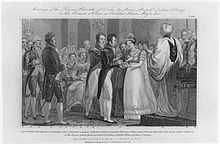
1818 engraving of the wedding of Charlotte and Leopold
The Prince Regent was impressed by Leopold, and told his daughter that Leopold "had every qualification to brand a woman happy". Charlotte was sent dorsum to Cranbourne on ii March, leaving Leopold with the Prince Regent. On fourteen March, an announcement was made in the British Firm of Eatables to neat acclaim, with both parties relieved to accept the drama of the Princess'due south romances at an stop.[72] Parliament voted through a bill naturalising Leopold equally a British citizen,[73] awarded him £50,000 per year (equivalent to £3.91 million in 2020),[74] purchased Claremont Business firm for the couple, and immune them a generous single payment to set up upwardly house.[75] George too contemplated making Leopold a royal duke, the Knuckles of Kendal, though the program was abandoned due to authorities fears that information technology would draw Leopold into party politics and suggestions that condign a 'mere duchess' would be viewed equally a demotion for Charlotte.[76] Fearful of a repetition of the Orange fiasco, George limited Charlotte'south contact with Leopold; when Charlotte returned to Brighton, he allowed them to meet but at dinner, and never allow them be alone together.[77]
The marriage anniversary was set for 2 May 1816. On the wedding day, huge crowds filled London; the nuptials participants had great difficulties in travelling. At nine o'clock in the evening in the Crimson Drawing Room at Carlton House, with Leopold dressing for the commencement time equally a British General (the Prince Regent wore the uniform of a Field Align), the couple were married. Charlotte'south wedding dress cost over £10,000 (equivalent to £782,579 in 2020).[74] The only mishap was during the ceremony, when Charlotte was heard to giggle when the impoverished Leopold promised to endow her with all his worldly goods.[78]
Matrimony and death [edit]

Princess Charlotte and Prince Leopold. Portrait by George Dawe
The couple honeymooned at Oatlands Palace, the Knuckles of York's residence in Surrey. Neither was well and the firm was filled with the Yorks' dogs and the aroma of animals. Notwithstanding, the Princess wrote that Leopold was "the perfection of a lover".[79] Two days after the wedlock, they were visited past the Prince Regent at Oatlands; he spent ii hours describing the details of military uniforms to Leopold, which according to Charlotte "is a neat mark of the most perfect good humor".[80] Princess Charlotte and her husband returned to London for the social season, and when they attended the theatre, they were invariably treated to wild applause from the audience and the singing of "God Relieve the King" from the company. When she was taken ill at the Opera, there was great public concern about her condition. It was appear that she had suffered a miscarriage.[81] On 24 August 1816, they took up residence for the first time at Claremont.[82]
Leopold's physician-in-ordinary,[83] Christian Stockmar (later, as Businesswoman Stockmar, adviser to both Queen Victoria and Prince Albert),[84] wrote that in the first six months of the marriage, he had never seen Charlotte wear annihilation that was non simple and in good taste. He also noted that she was much more calm and in control of herself than she used to be, and attributed this to Leopold'southward influence.[83] Leopold wrote after, "Except when I went out to shoot, we were together ever, and we could be together, nosotros did non tire."[85] When Charlotte became too excited, Leopold would say only, "Doucement, chérie" ("Gently, my love"). Charlotte both accustomed the correction and began calling her husband "Doucement".[86]
The Coburgs, as they came to be called, spent the Christmas holidays at the Brighton Pavilion with various other royals. On vii January, the Prince Regent gave a huge ball there to celebrate Charlotte's 21st altogether, but the Coburgs did not attend, having returned to Claremont and preferring to remain in that location quietly. At the cease of April 1817, Leopold informed the Prince Regent that Charlotte was again pregnant, and that there was every prospect of the Princess carrying the babe to term.[87]

An engraving based on Sir Thomas Lawrence's painting of Charlotte, which she saturday for in her concluding days
Charlotte'due south pregnancy was the field of study of the most intense public interest. Betting shops apace ready up book on what sex the kid would exist. Economists calculated that the nativity of a princess would enhance the stock market by 2.5%; the birth of a prince would raise it 6%. Charlotte spent her time quietly, spending much time sitting for a portrait past Sir Thomas Lawrence.[88] She ate heavily and got petty do; when her medical team began prenatal care in August 1817, they put her on a strict diet, hoping to reduce the size of the child at nascency. The nutrition, and occasional haemorrhage, seemed to weaken Charlotte. Stockmar was amazed at a treatment he saw as outdated, and declined to bring together the medical team, believing that, equally a foreigner, he would be blamed if anything went wrong.[89]
Much of Charlotte'south day to day care was undertaken by Sir Richard Croft. Croft was non a doctor, but an accoucheur, much in style among the well-to-exercise.[90] Charlotte was believed to exist due to evangelize on 19 October, only every bit October ended, she had shown no signs of giving nascency, and drove out as usual with Leopold on Sunday 2 November.[91] On the evening of 3 November, her contractions began. Sir Richard encouraged her to practice, but would not let her eat: belatedly that evening, he sent for the officials who were to witness and attest to the majestic nascency. As the 4th of November became the fifth, it became clear that Charlotte might be unable to evangelize the kid, and Croft and Charlotte's personal physician, Matthew Baillie, decided to send for obstetrician John Sims.[92] However, Croft did not let Sims to run across the patient, and forceps were not used. According to Plowden in her book, they might have saved her and the child, though there was a very loftier mortality rate when instruments were used in the era before antiseptics.[93]
At ix o'clock in the evening of 5 November, Charlotte finally gave nascency to a big stillborn boy. Efforts to resuscitate him were in vain, and the noble observers confirmed that it was a handsome boy, resembling the Royal Family unit. They were assured that the mother was doing well, and took their go out. An exhausted Charlotte heard the news calmly, stating information technology was the will of God. She took some nourishment afterward her lengthy fast and seemed to exist recovering.[94] Leopold, who had remained with his wife throughout, patently took an opiate and collapsed into bed.[95]
Soon after midnight, Charlotte began vomiting violently and complaining of pains in her abdomen. Sir Richard was chosen, and was alarmed to discover his patient common cold to the touch on, breathing with difficulty, and bleeding. He placed hot compresses on her, the accepted treatment at the time for postpartum bleeding, simply the blood did non cease. He called in Stockmar and urged him to bring Leopold. Stockmar found Leopold difficult to rouse, and went to run across the Princess, who grabbed his hand and told him, "They have made me tipsy." Stockmar left the room, planning to endeavour again to rouse the Prince, merely was called dorsum by Charlotte'south phonation, "Stocky! Stocky!" He entered the room to discover her dead.[96]
Aftermath [edit]

Princess Charlotte'south funeral

Henry Brougham wrote of the public reaction to Charlotte's death, "Information technology really was as though every household throughout Cracking Britain had lost a favourite child."[97] The whole kingdom went into deep mourning; linen-drapers ran out of black cloth. Even the poor and homeless tied armbands of blackness on their clothes. The shops airtight for two weeks, as did the Royal Commutation, the Law Courts, and the docks. Even gambling dens shut downwards on the 24-hour interval of her funeral, every bit a marker of respect.[98] Wrote The Times, "It certainly does not vest to u.s. to repine at the visitations of Providence ... at that place is naught impious in grieving for that as a calamity."[99] Mourning was so complete that the makers of ribbons and other fancy goods (which could not be worn during the period of mourning) petitioned the authorities to shorten the menstruation, fearing they would otherwise become bankrupt.[97] Tributes include Felicia Hemans'south  Stanzas on the Death of the Princess Charlotte. and Letitia Elizabeth Landon's later Lines on the Mausoleum of the Princess Charlotte, at Claremont.. A dissenting note was struck by poet Percy Bysshe Shelley, who in his An Address to the People on the Death of the Princess Charlotte, indicated that the execution of three men the twenty-four hour period after the Princess'due south death for plotting to overthrow the government was a greater tragedy.[100]
The Prince Regent was prostrate with grief, and was unable to nourish his child's funeral. Princess Caroline heard the news from a passing courier, and fainted in shock. On recovering, she stated, "England, that groovy land, has lost everything in losing my ever dear daughter."[101] Fifty-fifty the Prince of Orange burst into tears at hearing the news, and his wife ordered the ladies of her court into mourning.[101] The greatest effect fell on Prince Leopold. Stockmar wrote years later, "November saw the ruin of this happy home, and the destruction at one accident of every hope and happiness of Prince Leopold. He has never recovered the feeling of happiness which had blest his short married life."[102] According to Holme, "without Charlotte he was incomplete. Information technology was equally if he had lost his middle."[102] Leopold remained a widower until remarrying in 1832 to Louise of Orleans when he had get Rex of the Belgians. His youngest daughter, afterwards known as Empress Carlota of Mexico, was named in honour of his lost wife.[103]
Prince Leopold wrote to Sir Thomas Lawrence:
Two generations gone. Gone in a moment! I have felt for myself, but I have also felt for the Prince Regent. My Charlotte is gone from the country—it has lost her. She was a good, she was an admirable woman. None could know my Charlotte as I did know her! Information technology was my study, my duty, to know her character, but it was my delight![104]
The Princess was cached, her son at her anxiety, in St. George'south Chapel, Windsor Castle, on xix November 1817. A monument past the sculptor Matthew Cotes Wyatt was erected, by public subscription, at her tomb.[105] Information technology was not long before the public began to pin blame for the tragedy. The Queen and the Prince Regent were blamed for not existence present at the birth, though Charlotte had specifically requested that they stay away.[105] Although the postmortem was inconclusive, many blamed Croft for his intendance of the Princess. The Prince Regent refused to blame Croft; withal, three months later Charlotte's death and while attention another young adult female, Croft snatched up a gun and fatally shot himself.[100] The "triple obstetric tragedy"—death of kid, mother, and practitioner—led to pregnant changes in obstetric practice, with obstetricians who favoured intervention in protracted labour, including in particular more liberal use of forceps, gaining basis over those who did not.[106]

An obelisk in memory of Charlotte was erected past the then Liberal Member of Parliament (MP) for Walsall, Robert Wellbeloved Scott, in the grounds of his country house (now Carmine Business firm Park, in Sandwell).[107] Having become badly damaged through age, the obelisk was restored in Baronial 2009,[108] at cost of £fifteen,000.[109]
Charlotte'due south expiry left the King without any legitimate grandchildren; his youngest surviving child was over xl. The newspapers urged the King's unmarried sons towards matrimony. One such leading commodity reached the Male monarch'south fourth son, Prince Edward, Knuckles of Kent and Strathearn, at his dwelling in Brussels, where he was living with his mistress, Julie de St Laurent. Edward quickly dismissed his mistress and proposed to Leopold's sister Victoria, Dowager Princess of Leiningen.[110] Their girl, Victoria, became Queen of the Britain in 1837.[111]
Ancestry [edit]
References [edit]
- ^ Chambers, p. half-dozen.
- ^ Chambers, pp. eight–9.
- ^ Chambers, pp. xiii–14.
- ^ a b Chambers, pp. fifteen–xvi.
- ^ Williams, p. 24.
- ^ Williams, p. 26.
- ^ Williams, p. 27.
- ^ a b c Williams, p. 28.
- ^ London Gazette & 16 February 1796.
- ^ Plowden, pp. 32–33.
- ^ Holme, p. 45.
- ^ Williams, pp. 28–29.
- ^ Plowden, pp. 43–44.
- ^ Holme, pp. 46–47.
- ^ a b Chambers, p. 16.
- ^ Plowden, p. 47.
- ^ Chambers, p. 17.
- ^ Chambers, pp. 18–xix.
- ^ a b Holme, p. 53.
- ^ Raessler, p. 133.
- ^ a b Holme, p. 69.
- ^ Holme, pp. 62–63.
- ^ Williams, p. 42.
- ^ Chambers, pp. 26–29.
- ^ Plowden, p. 86.
- ^ Williams, p. 50.
- ^ a b Holme, p. 68.
- ^ Plowden, p. 88.
- ^ Holme, p. 72.
- ^ Plowden, pp. 94–95.
- ^ Chambers, pp. 43–45.
- ^ Williams, p. 51.
- ^ Plowden, p. 102.
- ^ Williams, pp. sixty–63.
- ^ Chambers, p. 47.
- ^ Chambers, pp. 39–forty.
- ^ Chambers, pp. 68–69.
- ^ Plowden, pp. 130–131.
- ^ Plowden, p. 132.
- ^ Holme, pp. 122–123.
- ^ Chambers, p. 73.
- ^ Chambers, pp. 81–82.
- ^ Plowden, pp. 134–135.
- ^ Chambers, pp. 82–83.
- ^ Chambers, p. 91.
- ^ Greville's Diary, 18 September 1832, quoted in Aspinall, p. xvii.
- ^ Aspinall, p. xvii.
- ^ Williams, pp. 88–89.
- ^ Holme, pp. 196–197.
- ^ Plowden, pp. 149–150.
- ^ Plowden, pp. 156–160.
- ^ a b Plowden, pp. 161–163.
- ^ Chambers, p. 120.
- ^ a b Smith, p. 163.
- ^ Plowden, pp. 164–165.
- ^ Holme, p. 177.
- ^ Williams, p. 102.
- ^ Holme, p. 183.
- ^ a b Holme, p. 186.
- ^ Aspinall, p. 165; Williams, p. 107.
- ^ Aspinall, p. 169; Williams, p. 107.
- ^ Chambers, p. 138.
- ^ Williams, p. 111.
- ^ Plowden, p. 176.
- ^ Plowden, p. 178.
- ^ Plowden, p. 181.
- ^ Holme, pp. 206–207.
- ^ Holme, p. 210.
- ^ Holme, p. 211.
- ^ Holme, p. 213.
- ^ Plowden, pp. 188–189.
- ^ Stott, p. 248.
- ^ a b UK Retail Price Index inflation figures are based on information from Clark, Gregory (2017). "The Annual RPI and Average Earnings for Uk, 1209 to Present (New Series)". MeasuringWorth . Retrieved 2 December 2021.
- ^ Chambers, p. 164.
- ^ Stott, p. 248, not least considering it might prompt unflattering comparisons with the last Duchess of Kendal, George I's mistress Melusine von der Schulenburg.
- ^ Holme, p. 215.
- ^ Chambers, pp. 164–167.
- ^ Holme, p. 223.
- ^ Smith, p. 164.
- ^ Holme, pp. 224–225.
- ^ Chambers, p. 174.
- ^ a b Holme, p. 227.
- ^ Pakula, p. 33.
- ^ Chambers, p. 177.
- ^ Holme, p. 228.
- ^ Plowden, p. 201.
- ^ Williams, p. 133.
- ^ Chambers, pp. 188–189.
- ^ Chambers, p. 1.
- ^ Holme, pp. 237–238.
- ^ Williams, pp. 134–135.
- ^ Plowden, p. 206.
- ^ Plowden, pp. 206–207.
- ^ Williams, p. 136.
- ^ Chambers, pp. 193–194.
- ^ a b Williams, p. 137.
- ^ Holme, pp. 240–241.
- ^ Plowden, pp. 208–209.
- ^ a b Williams, p. 240.
- ^ a b Williams, pp. 138–139.
- ^ a b Holme, p. 241.
- ^ McAllen, pp. xii, 29.
- ^ Chambers, p. 201, some references omit the word "also".
- ^ a b Chambers, p. 201.
- ^ Gibbs et al. 2008, p. 471.
- ^ Maull, Jayne. "'Forgotten Princess' remembered at Ruddy House Park event". Sandwell MBC. Retrieved 30 June 2018.
- ^ Betimes (28 August 2009). "north/a". Great Barr Observer.
- ^ "Restoration of the Obelisk". Friends of Blood-red House Park. Retrieved xxx June 2018.
- ^ Chambers, pp. 202–204.
- ^ "No. 19509". The London Gazette. xx June 1837. p. 1581.
- ^ Louda, Jiří; Maclagan, Michael (1999) [1981]. Lines of Succession: Heraldry of the Royal Families of Europe (2nd ed.). London: Piddling, Brown. p. 30. ISBN978-0-316-84820-6.
- ^ Genealogie ascendante jusqu'au quatrieme degre inclusivement de tous les Rois et Princes de maisons souveraines de 50'Europe actuellement vivans [Genealogy up to the fourth degree inclusive of all the Kings and Princes of sovereign houses of Europe currently living] (in French). Bourdeaux: Frederic Guillaume Birnstiel. 1768. pp. five, 53.
Bibliography [edit]
- Aspinall, Arthur (1949). Letters of the Princess Charlotte 1811–1817. London: Home and Van Thal.
- Chambers, James (2007). Charlotte and Leopold . London: Onetime Street Publishing. ISBN978-ane-905847-23-5.
- Gibbs, Ronald S.; Danforth, David N.; Karlan, Beth Y.; Haney, Arthur F. (2008). Danforth'south obstetrics and gynecology. Lippincott Williams & Wilkins. ISBN978-0-7817-6937-2.
- Holme, Thea (1976). Prinny's Daughter . London: Hamish Hamilton. ISBN978-0-241-89298-5. OCLC 2357829.
- "No. 13867". The London Gazette. xvi February 1796. p. 176.
- Pakula, Hannah (1997). An Uncommon Woman: The Empress Frederick, daughter of Queen Victoria, married woman of the Crown Prince of Prussia, mother of Kaiser Wilhelm. New York: Simon & Schuster. ISBN978-0-684-84216-5.
- Plowden, Alison (1989). Caroline and Charlotte. London: Sidgwick & Jackson. ISBN978-0-283-99489-0.
- Raessler, Daniel Thou. (2004). "Miles (née Guest), Jane Mary (c. 1762–1846)". In Matthew, H.C.One thousand.; Harrison, Brian (eds.). Oxford Dictionary of National Biography. Vol. 38. Oxford University Press. p. 133. ISBN978-0-19-861388-6.
- Smith, E.A. (2001). George 4. New Haven, Conn.: Yale University Press. ISBN978-0-300-08802-one.
- Stott, Anne One thousand. (2020). The Lost Queen. Pen & Sword. ISBN978-one-52673-644-iv.
- Williams, Kate (2008). Becoming Queen Victoria. New York: Ballantine Books. ISBN978-0-345-46195-vii.
- McAllen, M. Yard. (2014). Maximilian and Carlota: Europe's Last Empire in Mexico. San Antonio, Texas: Trinity Academy Press. ISBN9781595341853.
External links [edit]
Source: https://en.wikipedia.org/wiki/Princess_Charlotte_of_Wales
0 Response to "Training Princess Pleasing the Mother Again"
Post a Comment