How to Upload Extra File to Amazon Bean Stalk Php
In 2011, Amazon extended the functionality of its cloud with a new service — AWS Elastic Beanstalk, which simplifies the lives of companies that use Amazon Spider web Services (AWS). Since then, numerous companies deploy applications using Elastic Beanstalk to facilitate the deployment and scaling of their web workloads. In this article, nosotros will explore the key features and benefits of the service, key deployment considerations and 4 steps it takes to deploy applications using Rubberband Beanstalk.
Bulldoze your digital transformation to the next level with our world-class cloud development services
Contact us
The Purpose and Core Capabilities
Since its emergence in 2011, more 19,000 websites have come to rely on this service. What is AWS Elastic Beanstalk and what does it practice?
The Core Characteristics of AWS Rubberband Beanstalk
AWS Rubberband Beanstalk encompasses processes and operations connected with the deployment of web apps into the cloud surround, as well as their scaling.
Elastic Beanstalk automates the deployment by putting forrard the required capacity, balancing the load, autoscaling and the monitoring of software efficiency and performance. All that is left for a developer to do is to apply the code. In these conditions, the application possessor has overall control over the chapters that AWS provides for the software and can access it at whatsoever time.
How does it piece of work? It manages a number of AWS services, such as S3, EC2, Elastic Load Balancers, autoscaling, etc., by providing a special abstraction layer over the server and the operating system. Yet, users see information technology equally an off-the-shelf set of the platform and the operating system, for example, 64bit Amazon Linux 2014.03 v1.1.0 that is based on Ruby 2.0.
Below are some of its configuration specifics:
- Supports Apache, Passenger, Cyberspace Information Services (IIS) and Nginx servers and Coffee, PHP, .NET, Python, Go and Cherry programming languages
- Supports a Puma or a Rider app stacks for Rails
- Configures an SQL server via Amazon RDS
- CloudWatch-based server monitoring
- AWS CLI-based deployment of new versions
Deployment based on Elastic Beanstalk requires the definition of a number of components, such as an "application," a "version," a "configuration template" and an "environs." An application is a project logical container, a version is its deployable built and a configuration template contains configuration-related information for the software and the Rubberband Beanstalk environment. Equally for the environment, it brings together a configuration and a version and deploys the two components.
Reasons to Deploy Apps in Elastic Beanstalk
Mastered to facilitate deployment to AWS, Elastic Beanstalk has meaning advantages that help businesses ameliorate their efficiency. They are :
Quick server configuration. Attributable information technology to automation, Rubberband Beanstalk allows companies to create a web service in practically no time. Users merely upload their codes and enjoy a smoothly running web service in less than one 60 minutes while the service performs the setup, configuration and delivery of other AWS services.
In such a manner, developers save a lot of time, as they do not demand to handle numerous components and tasks required to build a web app. So, database setup, Linux package installation, Load Balancer configuration and many other operations are the responsibility of Elastic Beanstalk. Also, it helps avert errors that a developer tin can make since everything has been already taken into consideration by the vendor and in that location is no chance of missing anything.
Flexibility and ample opportunity for customization. Elastic Beanstalk allows developers to continue everything under the radar, equally it is AWS's service. It also enables easy updates and modifications. In add-on, users can choose the size of their instances or increase the number of front-finish servers, which allows them to match the load and server needs.
Free-of-charge basis. If a company already uses AWS, it is only charged for AWS resources that enable storage and the functioning of applications, while the other functionality is gratis. The built-in autoscaling of Elastic Beanstalk enables cost-saving past adding actress servers.
Enhanced security. Elastic Beanstalk too reaps profits from the fact that AWS steps up the security policy. For example, the peculiarity of server configuration allows servers to communicate only when it is required, while a developer may find this adjustment to exist quite difficult to do manually.
Unfortunately, this service is not without certain disadvantages: higher deployment reliability wouldn't go amiss, as well as higher transparency and more than comprehensive documentation.
Deployment Considerations
The fact that companies deploy applications with AWS Elastic Beanstalk for farther use in the cloud makes them consider and follow specific conditions to ensure powerful performance and high reliability of workloads.
Scalability
Whether it is scaling in or scaling out, scalability is an indispensable prerequisite of an efficient cloud infrastructure. Companies can achieve it by making the most of cloud elasticity, which means that they are able to easily learn or release resources depending on their requirements.
If configured properly, Rubberband Beanstalk leverages cloud elasticity by automatic scaling up or scaling down in response to a specific situation based on resource metrics from your environment. Autoscaling functionality allows companies to vary chapters against usage fluctuations.
When possible, applications deployed by Elastic Beanstalk should exist stateless and based on loosely coupled resilient components that support easy scaling out.
Fault-Tolerance
When designing any software that is to exist deployed in the cloud, the fundamental is to foresee possible outages and aberrations and make an app ready to withstand them. That is why developers should always consider automatic failover and design, and implement and deploy having this consideration in heed.
To enable it, apply Availability Zones for Amazon RDS and Amazon EC2 instances, Amazon CloudWatch for better visibility into software performance parameters, and react accordingly to possible abnormalities. Too, certain automobile-scaling settings let Amazon EC2 to maintain a fixed number of its instances so that damaged ones are replaced past good for you instances. Regular automated backups is another important feature that allows Amazon RDS to secure against information loss.
Connectivity
To ensure faultless deployments, Elastic Beanstalk requires proper connectivity with instances in the surround. Depending on the type of Amazon VPC surround, the configuration should be equally follows:
- Single-instance environments: additional configuration is non required, as Rubberband Beanstalk provides every instance with a public IP that allows them to access the Net directly
- Load-balancing, auto-scaling environments that have ane public subnet: additional configuration is not required every bit all instances are assigned a public IP address for Net admission
- Load-balancing, auto-scaling environments that accept public and individual subnets:
- Brand a load balancer in the public subnet to route downstream traffic from the Cyberspace to instances
- Create a cyberspace accost translation device to road upstream traffic from instances to the Net
- Develop downstream and upstream routing rules for instances that are within the private subnet
- Prepare security groups for the cyberspace address translation device and other instances, which enables Internet communication
Security
While AWS is in charge of the security of the physical facilities that are part of the environments, companies are in the first case responsible for information quality and security. That is why, to protect data that their applications exchange with clients, companies need a proper SSL configuration.
It enables the encryption of information that is transmitted between the Rubberband load balancer and clients, equally past default the traffic betwixt instances and the load balancer are not encrypted.
Persistent Storage
Due to their specifics, Amazon EC2 instances do not have persistent local storages, which is why they are non saved in the file system later on their termination, and new instances starting time by default. To avoid this, businesses need to create their applications in such a manner that they can shop data in persistent storages, which AWS provides in a great number.
Regular Upgrades
Although Elastic Beanstalk makes regular updates of platform configurations, it does non provide that of running environments. And so, information technology is the responsibility of each specific company to keep their running environments upwardly to date.
How to Deploy a PHP Application Using Elastic Beanstalk
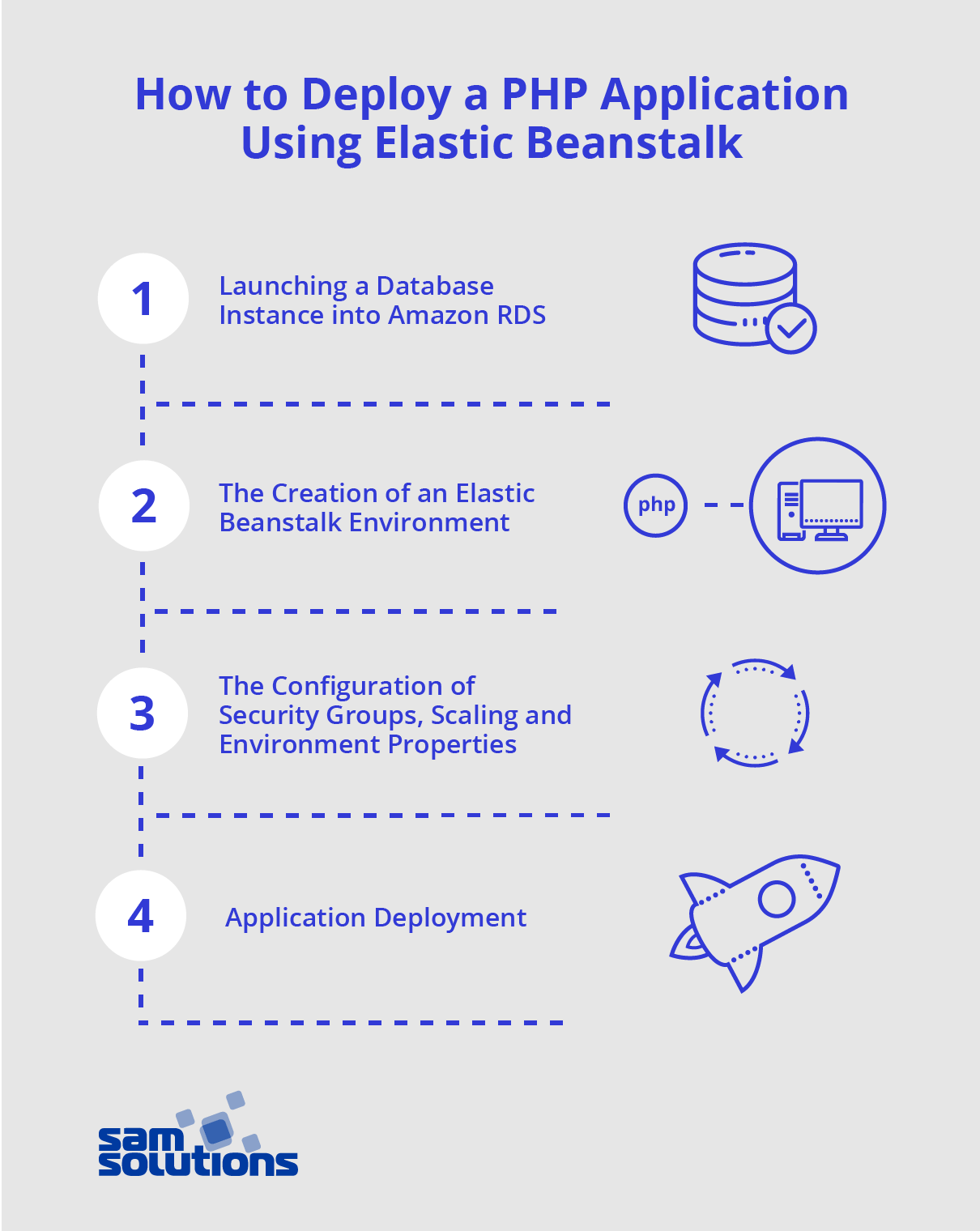
Later companies have fabricated certain that they meet all of the requirements from the above checklist, they can proceed to the deployment itself. By mode of example, we'll explore how to deploy a PHP application to AWS Elastic Beanstalk. However, equally mentioned higher up, an app can besides be written in Coffee, .NET, Python, Go or Blood-red.
To provide ultimate accuracy and truth in relation to the procedure details, the beneath guideline is closely based on Amazon'south tutorial. In this specific instance, we mean a sample PHP app that stores text data in a MySQL database, and resources are launched in a default Amazon Virtual Private Deject.
1.Launching a Database Case into Amazon RDS
Launching a database example into Amazon RDS is a prerequisite for the utilize of an external database together with an app that runs with the assistance of Elastic Beanstalk. Make sure that you choose a Multi-AZ MySQL database case in the Amazon RDS console to enable successful database failovers if its instance goes out.
To launch an RDS database example in a default VPC, developers demand to perform the post-obit operations:
- Open the Amazon RDS'due south console.
- Choose "Instances" -> "Launch DB instance" -> database engine -> "Adjacent."
- If prompted, choose a use case.
- In "Specify DB details," adjust the required settings. Focus on "DB instance class" to select example size that fits your retentiveness and CPU power requirements and prepare "Create replica in different zone" in "Multi-AZ deployment" to enable high availability. Then, select "Side by side."
- Input ebdb every bit the database proper name, under "Database options."
- Accommodate other default settings if required and press "Launch DB instance."
Later you accept finished it, change the security grouping to let downstream traffic to access only a specific port. This rule provides admission permission to all of the security group resources. At that place is a scenario to modify the access rules:
- Open the console and select "Instances"
- Choose the instance proper name to get details about it
- Under the section "Security and network," there is the DB instance-associated security group. Follow the link to view it in the EC2 panel.
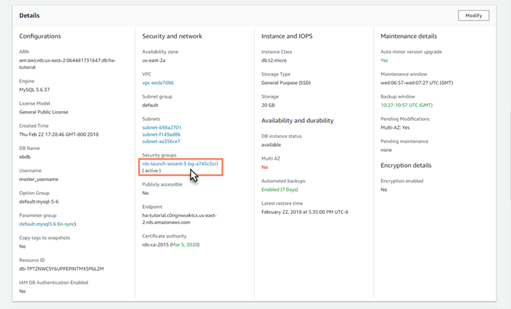
- In the details of the security group, cull "Entering" -> "Edit" -> "Add Rule"
- Select your database engine as a type
- Input sg- to see available security groups and select the electric current one to enable its resources to get traffic from other group resources
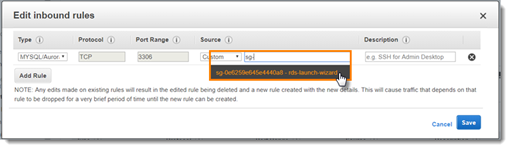 7. Salve
2. The Cosmos of an Elastic Beanstalk Surroundings
The development of an Rubberband Beanstalk environment is performed with the apply of the AWS Direction Console, where y'all should choose the PHP platform and accept settings by default and a lawmaking. Open the Elastic Beanstalk console with a preconfigured link:
- Select a platform that uses the required language
- Select " Awarding" as an app lawmaking
- Select "Review and launch" and cheque available options
- Press "Create an app"
During this process, EC2 instance, instance security group, load balancer, load balancer security group, autoscaling group, Amazon S3 bucket, Amazon CloudWatch alarms, AWS CloudFormation stack and the domain name are created. The termination of Rubberband Beanstalk means that all of these resources are terminated.
iii. The Configuration of Security Groups, Scaling and Surround Backdrop
To create another security grouping in the surroundings, yous should do the post-obit:
- Open the Elastic Beanstalk console and find the management page of your environs
- Select "Configuration" and choose "Modify" for "Instances"
- Select the required security group that y'all need to attach to the instances and utilise
- Later on reading the warning, press "Ostend"
To send the connection data to your environment, you will need the environment properties. For their configuration, put through the post-obit steps:
- Open the Elastic Beanstalk console and find the management page of your environs.
- Select "Configuration" and choose "Modify" for "Software."
- In "Environment properties," provide information that your app will use for the cosmos of a connectedness cord. To ensure that the environment is uniform with environments with RDS DB instances, use the following information:
| RDS_HOSTNAME | Database example hostname * Endpoint – for Amazon RDS panel characterization |
| RDS_PORT | Database instance connection port * Port – for Amazon RDS console label |
| RDS_DB_NAME | Database name, ebdb. * DB Name – for Amazon RDS console label |
| RDS_USERNAME | Database user name * Username – for Amazon RDS console characterization |
| RDS_PASSWORD | Database password |
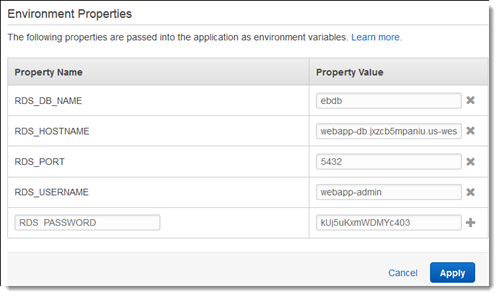
- Apply
To ensure high scalability of your environment, create an auto-scaling group that includes at to the lowest degree two instances:
- Open the Elastic Beanstalk console and find the direction page of your environment
- Select "Configuration" and cull "Modify" for "Capacity"
- Select "Min instances" in the "Auto Scaling Group" and set two (two)
- Use
iv. Awarding Deployment
Finally, your environs is ready for running the application and for the connexion to Amazon RDS. All that if left to practice is to deploy an app in the environment:
- Open up the Elastic Beanstalk panel and notice the management page of your environment
- Select "Upload and Deploy"
- Select "Choose File" and choose the source packet with the dialog box
- Deploy and select the URL to open the new website
Nosotros develop innovative cloud-based solutions for clients around the world
LEARN MORE
To Apply or Not to Utilize Rubberband Beanstalk?
While the conclusion on whether or not to deploy apps to Rubberband Beanstalk is up to each specific business concern, this service definitely has considerable advantages. If practical correctly, it helps accelerate and streamline app relocation to the cloud.
Withal, to avert errors, foreclose incidents and successfully deploy apps, companies should closely follow vendor recommendations or turn to service providers who are well-versed in AWS, such equally SaM Solutions. All-encompassing expertise in the domain allows such companies to create fault-tolerant cloud infrastructures and provide robust functioning of web apps.
Source: https://www.sam-solutions.com/blog/how-to-deploy-an-application-using-aws-elastic-beanstalk/
0 Response to "How to Upload Extra File to Amazon Bean Stalk Php"
Post a Comment