Book Review of the Choice by Russell Roberts
volume extract
'She Was Committed to the Dark Side'
How My Best Friend's Wedding messed with Julia Roberts's image and changed rom-coms for expert.
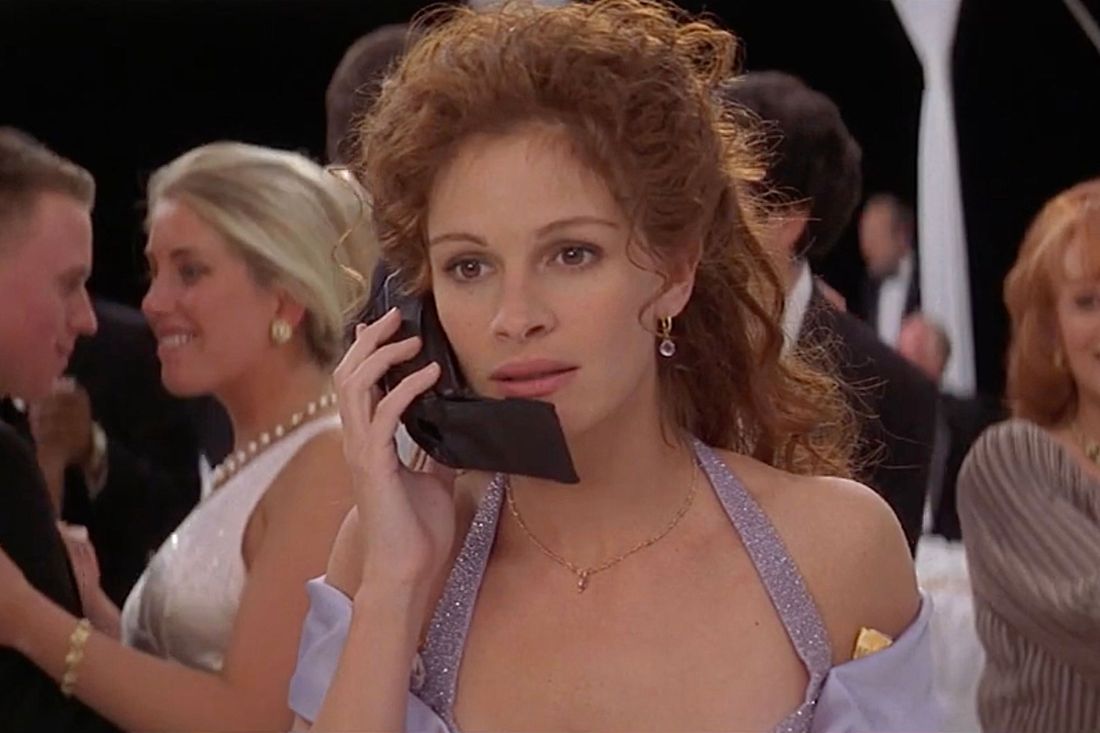
My All-time Friend's Wedding ceremony changed the rom-com genre. All it took was a spate of rewrites. Photograph: TriStar Pictures
My Best Friend'due south Wedding changed the rom-com genre. All it took was a spate of rewrites. Photo: TriStar Pictures
When TriStar Pictures announced that Julia Roberts, who'd broken out in Pretty Woman in 1990 and later on become the bailiwick of countless tabloid fixation, was set to star in another rom-com, no 1 was particularly surprised, Scott Meslow points out in his book, From Hollywood With Love. Only the projection was bolder than it offset appeared. As any fan of the 1997 film can attest, My Best Friend's Wedding is less a conventional happily always after, in which we traipse forth with our lovable protagonist long enough to see her stammer but eventually be rewarded with beloved in the end, and more than like a challenge to the audience: "How much practice yous like Julia Roberts, anyway?" Meslow asks. Enough to sympathize with her character Julianne as she swiftly and methodically sabotages a happy human relationship in the name of her ain selfish pursuits? Enough to sit past and lookout her non get the guy? Information technology was a role that was tough to write and even tougher to make convincing on screen. Here's the story backside it all, according to Meslow.
My Best Friend's Hymeneals didn't merely need the right star — it needed a filmmaker who understood how to make audiences intendance virtually a graphic symbol whose flaws were bodily flaws, and not just the cute "flaws" screenwriters designed to make a glamorous histrion seem more down-to-earth and approachable. P.J. Hogan was the right director for the task. "The main note [while developing and producing] Muriel's Wedding was, 'The main character's not sympathetic. We detest her,'" says Hogan. "And I was similar, 'Well … I love her.'" Julia Roberts had been a fan of Muriel's Wedding, and she was convinced Hogan, who had made audiences beyond the world care for Muriel Heslop, had the sensibility to walk the very specific tightrope My Best Friend'south Wedding would crave.
When Hogan sat down to read the script, he discovered, to his surprise, that My Best Friend's Hymeneals was a closer cousin to Muriel's Wedding than he had expected. "What really surprised me was that it wasn't actually very romantic," he says. "In fact, my experience of reading the screenplay was, 'Wow, I'm not sure I like her very much.' And usually in romantic comedies, everything the main character does in guild to win beloved and to find happiness is totally justified. Even if it'south kind of awful. What 1000000 Ryan does to Bill Pullman in Sleepless in Seattle is kind of awful. And as I was reading information technology, I was thinking, God, it's got that damn romantic comedy problem. She's kind of awful. And I got to the cease, and she didn't get the guy. And I idea, Oh, my God, that's the point. This takes the course and smashes information technology on the floor. Most romantic comedies are well-nigh how all'due south fair in dear and war, which is something I accept never really believed in. And this was a screenplay almost how all is not fair in love and war. Information technology was a romantic comedy that wasn't very romantic."
Hogan knew what My Best Friend'due south Wedding could be, but the question was: Did Julia Roberts have the same vision? In theory, the director is in accuse on a pic set — but when a studio is edifice an entire picture show around an A-lister, that star has tremendous power over the production, and Roberts'south deal allowed for a significant corporeality of creative oversight. Hogan agreed to meet with Roberts so he could figure out whether she saw My Best Friend's Wedding the same manner he did: equally a trenchant deconstruction of the same genre on which Roberts had quite literally congenital her ain superstardom. "I thought, Julia has to make a death-defying spring," Hogan says. "She has to bring the audience along with her, with the character, and somehow however have them not hating her by the terminate." He had been a fan of Roberts from afar, but meeting her — much similar Garry Marshall, Richard Gere, and seemingly anybody else who came into her orbit — left him awed at her sheer charisma in person. "I idea, immediately, This will work. I'll go with this actress anywhere," Hogan says. At the aforementioned time, she not only shared his vision for a rom-com as subversive as he wanted to brand — she took it further than he'd planned. "Julia was admittedly committed to Julianne'due south dark side — which no one, I recollect, had immune her to exercise in her previous [romantic comedies]," says Hogan. "She was and so committed to the dark side that I was a footling bit worried."
The next pace was finding the right actor to play Michael, the best friend who is then incredible that he tin ship someone as radiant equally Julia Roberts off the deep end. Actors in contention included Matthew McConaughey, Edward Burns, and Matthew Perry, whose career had exploded afterwards the 1994 premiere of Friends, and who briefly dated Julia Roberts around that time. (As for why Perry didn't land the part: "I remember it may take merely been I didn't want them to pause upwardly while shooting," says Hogan.)
But if non for 1 truly disastrous table read, My Best Friend's Wedding could have been a very unlike pic, because Hogan had an histrion he thought would be perfect for Michael in the dorsum of his mind all forth. "My first option was really Russell Crowe," says Hogan, whose wife, the writer-director Jocelyn Moorhouse, had worked with Crowe on 1991's Proof. "Russell was, I idea, probably the most amazing actor I had ever encountered. I kind of knew Russell was going to be a actually big star."
There was but ane big hurdle ahead: getting Julia Roberts to sign off on Crowe. Hogan was worried. "Julia had casting approval. No one was getting in this moving-picture show if Julia didn't approve," says Hogan.
Nevertheless, Hogan was convinced Crowe was the role player for the task, and so he invited him to a table read reverse Roberts and hoped sparks would wing. "I don't know what went incorrect," says Hogan. "Information technology was one of the worst table reads I've ever experienced. Russell was seated opposite Julia. He gripped that script, and he stared at that script, and he didn't await at her once. He read every line in a monotone. At one point, Julia was literally leaning over the table, staring, similar, inches from Russell's confront, trying to make eye contact. And he wouldn't look at her. At the end of the reading, Russell came up to me and said, 'I idea that went pretty well.' And then I knew: Russell was non going to exist in My Best Friend's Wedding."
Meanwhile, the creative team backside My Best Friend's Wedding was in a similarly far-ranging hunt for an actress to play Kimmy, Michael'south fiancée. "Kimmy was a really of import part, considering you're up against Julia Roberts, who the audition expects to go the guy at the end," says Hogan. "If Julia's character wipes the floor with Kimmy, the film isn't going to piece of work. Julia is a movie star, and film stars don't unremarkably share the screen with other moving-picture show stars. Only whoever plays Kimmy has to be a moving picture star also."
Still, Julia Roberts was concerned that an actress who was as well charismatic — and who Michael ultimately chooses over Julianne — might steal the movie from her birthday. Many, many immature actresses auditioned, including Drew Barrymore, Calista Flockhart, and Reese Witherspoon. In the end, Hogan settled on model-turned-extra Cameron Diaz, who had broken out in The Mask a few years earlier but was still i year away from the Farrelly Brothers' At that place'south Something About Mary, which would propel her to superstardom. "There was something about Cameron's sunniness that implied strength," Hogan says. Julia Roberts disagreed, preferring Drew Barrymore for Kimmy — and with casting approval, she could have booted Diaz out of consideration birthday. Hogan recalls "a lot of negotiation" that ended in a small-scale compromise: Diaz could stay if Hogan would cast Dermot Mulroney, whom Roberts "adored," every bit Michael.
With the core love triangle in place, there was one last major part to make full: George, the "best-looking, smartest, most loyal, nigh empathetic, nearly caring" grapheme in Ronald Bass's original draft. In the last cut, George — who, despite the picture show's title, is clearly Julianne's actual best friend — practically runs away with the entire movie, delivering the biggest laughs and anchoring the gorgeous, bittersweet catastrophe. But during casting, Hogan and Bass were however working on the rewrite; the original draft, in which George plays a smaller office, attracted most no attending from the actors they had originally targeted. "No name actor wanted that office," says Hogan. "If memory serves, Julia wanted Benicio del Toro. A bright actor, but … not known for his comedy."
So over again, neither was Rupert Everett, a journeyman British role player who had mainly appeared in historical dramas similar Trip the light fantastic toe With a Stranger and The Madness of King George. "Basically, Rupert played cads who got killed in the end," says Hogan. "And then when Rupert's amanuensis said, 'This function is for Rupert Everett,' I said, 'Well … I don't think and so.' And the agent was really, really ballsy almost it and said, 'No, I know Rupert. Rupert is this part.'" Hogan agreed to a meeting with Everett and walked away convinced that the droll, breezy, and witty actor might actually be what My All-time Friend's Wedding needed (though it nevertheless took a few screen tests before Everett formally won the role). Bass and Hogan's rewrite of the original spec script — which was already intended to beef upwardly George'south part in the story — was washed with Everett'due south vocalism in listen. The grapheme's nationality was fifty-fifty changed from American to British to conform him.
The new, larger role for George was just 1 of several ideas Hogan had suggested to punch up the original script. There was just 1 problem: Bass had a clause in his contract at the time that said no one could rewrite his scripts. "P. J. sat in my living room and he said, 'How are we going to get around this, that I tin can't rewrite y'all?'" says Bass. "And I said, 'We're going to ignore it. You and I both have to be satisfied with everything that happens.'"
The showtime rewrite session did not get entirely smoothly, due in big part to the presence of the Ronettes — Bass's all-female grouping of young screenwriting consultants. "I had been warned about the Ronettes, merely I thought it was sort of an urban myth," says Hogan. "But I arrived to work with Ron, and there was Ron in the middle of a big circle that reminded me of like a group therapy session. And they were all young women. And he would have an idea, and the Ronettes would pitch where the story could get at present, or what could happen here. With My Best Friend's Wedding ceremony, I think that was a really smashing way to work for Ron, because he was certainly non lacking for the female person perspective on that screenplay."
Just what worked for Ron Bass didn't piece of work for P. J. Hogan, who arrived to that first coming together wholly unprepared for the audience that would exist picking apart his every idea. "I sat down, and all the Ronettes took out their notepads, and Ron said, 'Shall we discuss the script and your ideas to improve it?'" says Hogan. "And I froze. It was like existence auditioned. And I just said, 'Ron, I can't piece of work this way, I'm sorry. I'1000 distressing to everybody in the room, but I actually can't do this. Would y'all mind, Ron, if the Ronettes left and I just worked with you?' And Ron was a footling upset with me. He thought information technology was very disrespectful to the Ronettes. Which, I suppose, it was."
Bass and Hogan'southward screenwriting partnership faced another examination early when Hogan came in with a concept for a seafood eatery sing-along to "I Say a Little Prayer," a Burt Bacharach and Hal David composition that was originally performed by Dionne Warwick. George — now pretending to be Julianne's fiancé — tells an elaborate prevarication about their courtship that crescendos in the entire restaurant joining in, including servers wearing footling red lobster claws on their hands. It is by far the most cartoonish scene in the picture, and Bass — whose script was in the slightly heightened mode of whatever skilful rom-com, but otherwise essentially realistic — was baffled by the decision to inject something then wacky into the movie. "I said, 'You lot realize, don't you, this is a six-minute scene where they're but fucking singing a vocal?'" says Bass. "He said, 'Aye. I wish it was x.'"
As ridiculous as the scene seemed on its face, Hogan also had a boxing-tested defense for information technology. Muriel's Wedding had relied heavily on the music of ABBA to illuminate the inner life of its awkward chief character, and Hogan had seen firsthand how much information technology helped audiences slip into her earth. Equally Hogan saw information technology, My Best Friend'southward Nuptials wouldn't just exist a romantic comedy. Information technology would be a stealth musical — albeit ane where the musical numbers would be parceled out sparingly enough that audiences wouldn't even consciously notice information technology. That's the reason why My Best Friend's Wedding opens with a dreamy, candy-colored rendition of "Wishin' and Hopin'"; or why a key emotional scene at Kimmy and Michael's hymeneals is scored with three goofballs harmonizing "Annie's Song" after sucking from a helium tank; and why the beginning part of the movie pivots effectually Kimmy's endearingly awful performance of "I Merely Don't Know What to Do with Myself" at a karaoke bar.
Hogan and Roberts ended upward dueling over the climax to that all-important karaoke scene, in what turned out to be a microcosm of the tonal tug-of-state of war at the heart of My Best Friend's Wedding. In the scene, Julianne has set Kimmy up to embarrass herself, secretly knowing that she can't comport a tune. She hopes that Michael will exist mortified and repulsed at his fiancée's awkwardness. Simply the plan backfires when Kimmy refuses to exist shamed, gamely sticking it out and belting out the last verses to an appreciative crowd while Michael looks on adoringly.
On the day the scene was shot, the big question was how Julianne would react to Kimmy's performance, and Hogan and Roberts found themselves at odds. Hogan wanted Julianne to admit that she'd lost the round and clap along with the rest of the crowd. Roberts felt that, even in defeat, Julianne wouldn't requite Kimmy an inch. "She did not want to do it," Hogan says. "She said, 'No. There's no way. I lost. I'm not clapping for her. I hate her.' And I said, 'Julia, delight, just give me one take where you handclapping. We've got to have some sort of light hither.' And Julia begrudgingly did it, but said, 'I'yard only doing it one time.' And of course she and I knew that would be the take I'd utilize." Sure plenty, that's the accept that made the movie.
Debates like this popped upward throughout the production of My Best Friend'south Wedding, with the tone of the unabridged movie itself hanging in the balance. While My Best Friend'due south Hymeneals generally plays it fairly light — especially in the extended interlude where George arrives in Chicago and pretends to exist Julianne's fiancé — there are also moments of dandy discomfort that can be blamed squarely on Julianne. In most romantic comedies, these transgressions are forgiven, or at least swept under the carpet, as necessary evils on the path to truthful love. Information technology may be horrible when Charles spurns Henrietta at the altar in Four Weddings and a Funeral, just the motion-picture show (and the audition) forgives him just minutes later, when Carrie shows upwardly at his door and justifies the heartbreak that led to that point. My Best Friend's Wedding has Julianne practice similarly awful things to blameless people, but without the comforting assurances that it'll all be worth it when Michael realizes they should have been together all along. When Julianne goads Kimmy into offer Michael a job opportunity Julianne knows he'll hate, or ghostwrites an email designed to create a rift between Michael and Kimmy's father, My Best Friend's Hymeneals is dancing correct on the border of making its heroine completely irredeemable.
The uneasy questions that were laced into the motion-picture show — merely how bad is Julianne? and what consequences should she face for it? — sparked feverish debate about the film'south ending from the very beginning. No one on the creative team behind My Best Friend's Wedding believed that Julianne should successfully win Michael'due south heart away from Kimmy; that was, after all, why Bass had written this story in the first place. Just if not Michael, couldn't Julianne run into somebody? The studio was concerned. "They didn't say she should go the guy, simply there was very friendly pressure for her to get a guy," says Hogan. "And, you know, the statement wasn't completely casuistic. She's at a nuptials. People meet people at weddings."
The original catastrophe for My All-time Friend's Wedding finds Julianne sitting alone at Michael and Kimmy's wedding, sadder and wiser as she lets the man she loves slip away. She goes outside to call George. All of a sudden, a devastatingly handsome unmarried man, played by John Corbett, approaches. "Hi, I'm Andy Connelly. We oasis't met," he says. And while Julianne (quite reasonably) responds that she's on a phone call and he's being rude, she decides to go dance with him later on some prodding from George, delivering the only bad advice he'southward given in the unabridged movie. "If I was in that location, yous wouldn't miss 1 trip the light fantastic toe," George sighs. "But I'yard not."
As Julianne twirls with Andy Connelly on the dance floor, giggling joyfully, the implication is unmistakable: Julianne is being rewarded, via the scales of catholic justice themselves, for giving upwards on her scheme at literally the last possible moment. Exam audiences — who are frequently dismissed, fairly or not, for pushing movies into safer and blander directions — admittedly despised this mealy-mouthed compromise of an ending. Bass witnessed information technology immediate at an early on exam screening in Arizona. "The air in the room just disappeared," says Bass. "The whole point of the picture show was that she would survive not getting the guy. They hated that so much. That's exactly what they didn't desire." Hogan was similarly horrified. "I had been actually worried that the audience would turn on the character — and in that first preview, the audition did turn on the character," he says. "In a big way. They wanted to tear the film off the screen." Sony Pictures executive John Calley stalked upwards to Bass and delivered an ultimatum: "Set this. You've got until tomorrow at two o'clock."
Rattled, both Bass and Hogan left the screening and tried to effigy out what, if anything, could relieve My All-time Friend's Wedding without compromising everything they liked about it in the start place. Hogan was flummoxed, and comments from a focus group held immediately after the screening didn't offer much useful criticism. One woman suggested that Julianne deserved to exist alone forever. A human said that if either of his two daughters acted similar Julianne had acted, he'd kicking them out of his house.
In the middle of this panic, it was Jerry Zucker — the producer once intended for the director'due south chair — who had the answer: While the exam scores were daunting, My All-time Friend's Wedding was actually a lot closer to the movie it needed to exist than it might seem. From his seat, he observed that the audience had really enjoyed near of the motion-picture show. It was merely near the end — when Kimmy had instantly forgiven Julianne for her many transgressions, and when Julianne had later been rewarded with a charming stranger on the dance flooring — that they turned on My Best Friend'south Wedding altogether.
This romantic comedy, which had been then advisedly engineered to interrogate its heroine, had ultimately gone likewise easy on her. A precise series of reshoots were conceived and shot to fix that problem. First came the climactic confrontation betwixt Julianne and Kimmy at Comiskey Park, which was tweaked so Kimmy would explicitly telephone call out Julianne'south awful behavior instead of forgiving her right away. "You kissed him! At my parents' firm! On my wedding day!" she yells.
And when Julianne tries to reply, she cuts her off: "Shut up. Now: I love this human, and there is no way I'one thousand gonna give him up to some ii-faced, big-haired nutrient critic." The second, virtually essential ready came downward to the ending, which had a very particular needle to thread. No i wanted to sentry a Julia Roberts rom-com with Julia Roberts sitting alone and miserable at the end. Just a deus ex machina with John Corbett's smiling face hadn't worked either. Wasn't there some way My Best Friend's Nuptials could land between those two poles? How most in the form of the movie'southward best-loved character, who was otherwise tragically absent from its closing scenes?
My Best Friend'south Wedding's actual ending is every bit sublime as that of whatever romantic comedy of the era. As Julianne sits alone at the wedding ceremony, her cell phone rings. It'southward George, of form, checking in on his friend one last time. "I tin only picture you lot there, sitting alone at your table in your lavender gown," he says. "Did I tell you my gown was lavender?" she replies.
As "I Say a Little Prayer" plays over the soundtrack, George delivers his big speech, teasing Julianne about a mystery man earlier he's revealed to have shown up in person to sweep her off to the dance floor. "Although y'all quite correctly sense that he is gay — like most devastatingly handsome unmarried men of his age are — you lot think, What the hell. Life goes on," he says. "Maybe in that location won't exist marriage. Mayhap there won't be sex. Merely past God, there'll be dancing."
To Ron Bass, this belatedly-in-the-game rewrite had the added bonus of bringing My All-time Friend's Wedding closer to the kind of movie he had wanted to make all along. "The point of the movie is that the person you love the most in your life doesn't have to be the person you're sleeping with," says Bass. "It might exist your child. It might exist your parent. It might be your colleague at work. It might be your all-time social friend. Information technology'south the person who you love. And it's not a crime to say that that honey was the near important matter to her."
My Best Friend'southward Wedding opened on June twenty, 1997. It was a date that was widely regarded effectually Hollywood every bit a sign that the studio had no religion in the movie, considering it was contrary what was sure to be i of the biggest blockbusters of the summer: Batman & Robin, which featured George Clooney's first (and last) performance as the Caped Crusader. "Everybody told us nosotros were fucked," says Hogan. Even Roberts's agent suggested she should spend the summertime promoting her other movie, the action-thriller Conspiracy Theory, which wasn't due to hit theaters until August.
Though Batman & Robin premiered on top that first weekend,
every bit anybody had predicted, it collapsed after some brutal discussion-of-mouth reviews by its second. Meanwhile, My Best Friend'southward Wedding endured, drawing audiences throughout the unabridged summer. Past the time Conspiracy Theory hit theaters that Baronial, My All-time Friend'due south Wedding had already grossed well over $100 one thousand thousand, becoming Roberts's biggest hit at the U.S. box part since Pretty Woman.
While Roberts never made a rom-com quite as unconventional again, she had proved that there was an appetite for romantic comedies that challenged a series of tropes that were, by 1997, already offset to feel a little entrenched. At that place are few more reliable premises for a romantic comedy than a love triangle, merely Roberts had harnessed her ain star ability, and her status as a rom-com heroine, to make ane in which the resolution could be genuinely surprising to the audience. "I felt like Julia never got her due from My Best Friend's Wedding," says Hogan. "You lot know, that's the great thing nearly Julia. She wanted to mess with her epitome. She really wanted to. She just believed that somebody in love is capable of doing terrible things. And if somebody said, 'You're messing with the cash moo-cow here' … Julia never cared about that." If yous could make a rom-com where Julia Roberts doesn't get the human being of her dreams and terminate up with a blockbuster-size hitting … well, what other kinds of romantic comedies might audiences be interested in seeing?
Excerpted from the volume FROM HOLLYWOOD WITH LOVE by Scott Meslow. Copyright © 2022 by Scott Meslow. Reprinted by permission of Dey Street Books, an imprint of William Morrow/HarperCollins Publishers.
Things you buy through our links may earn us a commission.

Source: https://www.vulture.com/2022/02/my-best-friends-wedding-ending-changed.html
0 Response to "Book Review of the Choice by Russell Roberts"
Post a Comment